
topology
topology#
import qrules.topology
Functionality for Topology and Transition instances.
Main interfaces
Topologyand its builder functionscreate_isobar_topologies()andcreate_n_body_topology().Transitionand its two implementationsMutableTransitionandFrozenTransition.
- class FrozenDict(mapping: Optional[Mapping] = None)[source]#
Bases:
Hashable,Mapping,Generic[KT,VT]An immutable and hashable version of a
dict.FrozenDictmakes it possible to make classes hashable if they are decorated withattr.frozen()and containMapping-like attributes. If these attributes were to be implemented with a normaldict, the instance is strictly speaking still mutable (even if those attributes are aproperty) and the class is therefore not safely hashable.Warning
The keys have to be comparable, that is, they need to have a
__lt__()method.
- class Edge(originating_node_id: Optional[int] = None, ending_node_id: Optional[int] = None)[source]#
Bases:
objectStruct-like definition of an edge, used in
Topology.edges.- originating_node_id: Optional[int]#
Node ID where the
Edgestarts.An
Edgeis incoming to aTopologyif itsoriginating_node_idisNone(seeincoming_edge_ids).
- ending_node_id: Optional[int]#
Node ID where the
Edgeends.An
Edgeis outgoing from aTopologyif itsending_node_idisNone(seeoutgoing_edge_ids).
- class Topology(nodes: Iterable[int], edges: Mapping[int, Edge])[source]#
Bases:
objectDirected Feynman-like graph without edge or node properties.
A
Topologyis directed in the sense that its edges are ingoing and outgoing to specific nodes. This is to mimic Feynman graphs, which have a time axis. Note that aTopologyis not strictly speaking a graph from graph theory, because it allows open edges, like a Feynman-diagram.The edges and nodes can be provided with properties with a
Transition, which contains atopology.As opposed to a
MutableTopology, aTopologyis frozen, hashable, and ordered, so that it can be used as a kind of fingerprint for aTransition. In addition, the IDs ofedgesare guaranteed to be sequential integers and follow a specific pattern:incoming_edge_ids(initial_states) are always negative.outgoing_edge_ids(final_states) lie in the range0...n-1withnthe number of final states.intermediate_edge_idscontinue counting fromn.
See also
MutableTopology.organize_edge_ids().Example
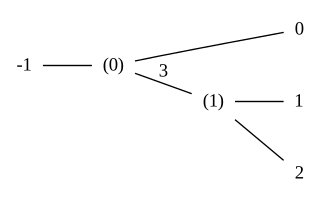
Isobar decay topologies can best be created as follows:
>>> topologies = create_isobar_topologies(number_of_final_states=3)
>>> len(topologies)
1
>>> topologies[0]
Topology(nodes=..., edges=...)
- edges: FrozenDict[int, Edge]#
Mapping of edge IDs to their corresponding
Edgedefinition.
- incoming_edge_ids: FrozenSet[int]#
Edge IDs of edges that have no
originating_node_id.Transition.initial_statesprovide properties for these edges.
- outgoing_edge_ids: FrozenSet[int]#
Edge IDs of edges that have no
ending_node_id.Transition.final_statesprovide properties for these edges.
- is_isomorphic(other: Topology) bool[source]#
Check if two graphs are isomorphic.
Returns
Trueif the two graphs have a one-to-one mapping of the node IDs and edge IDs.Warning
Not yet implemented.
- relabel_edges(old_to_new: Mapping[int, int]) Topology[source]#
Create a new
Topologywith new edge IDs.This method is particularly useful when creating permutations of a
Topology, e.g.:>>> topologies = create_isobar_topologies(3) >>> len(topologies) 1 >>> topology = topologies[0] >>> final_state_ids = topology.outgoing_edge_ids >>> permuted_topologies = { ... topology.relabel_edges(dict(zip(final_state_ids, permutation))) ... for permutation in itertools.permutations(final_state_ids) ... } >>> len(permuted_topologies) 3
- get_originating_node_list(topology: Topology, edge_ids: Iterable[int]) List[int][source]#
Get list of node ids from which the supplied edges originate from.
- class MutableTopology(nodes: Iterable[int] = NOTHING, edges: Mapping[int, Edge] = NOTHING)[source]#
Bases:
objectMutable version of a
Topology.A
MutableTopologycan be used to conveniently build up aTopology(see e.g.SimpleStateTransitionTopologyBuilder). It does not have restrictions on the numbering of edge and node IDs.- nodes: Set[int]#
See
Topology.nodes.
- edges: Dict[int, Edge]#
See
Topology.edges.
- add_node(node_id: int) None[source]#
Adds a node with number
node_id.- Raises
ValueError – if
node_idalready exists innodes.
- add_edges(edge_ids: Iterable[int]) None[source]#
Add edges with the ids in the
edge_idslist.- Raises
ValueError – if
edge_idsalready exist inedges.
- attach_edges_to_node_ingoing(ingoing_edge_ids: Iterable[int], node_id: int) None[source]#
Attach existing edges to nodes.
So that the are ingoing to these nodes.
- Parameters
- Raises
ValueError – if an edge not doesn’t exist.
ValueError – if an edge ID is already an ingoing node.
- organize_edge_ids() MutableTopology[source]#
Organize edge IDS so that they lie in range
[-m, n+i].Here,
mis the number ofincoming_edge_ids,nis the number ofoutgoing_edge_ids, andiis the number ofintermediate_edge_ids.In other words, relabel the edges so that:
incoming edge IDs lie in the range
[-1, -2, ...],outgoing edge IDs lie in the range
[0, 1, ..., n],intermediate edge IDs lie in the range
[n+1, n+2, ...].
- freeze() Topology[source]#
Create an immutable
Topologyfrom thisMutableTopology.You may need to call
organize_edge_ids()first.
- class InteractionNode(number_of_ingoing_edges: int, number_of_outgoing_edges: int)[source]#
Bases:
objectHelper class for the
SimpleStateTransitionTopologyBuilder.
- class SimpleStateTransitionTopologyBuilder(interaction_node_set: Iterable[InteractionNode])[source]#
Bases:
objectSimple topology builder.
Recursively tries to add the interaction nodes to available open end edges/lines in all combinations until the number of open end lines matches the final state lines.
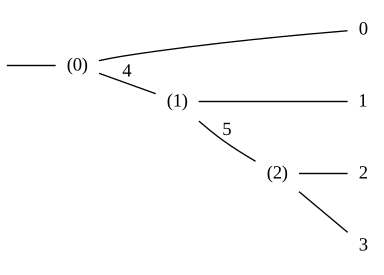
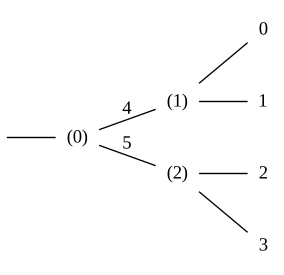
- create_isobar_topologies(number_of_final_states: int) Tuple[Topology, ...][source]#
Builder function to create a set of unique isobar decay topologies.
- Parameters
number_of_final_states – The number of
outgoing_edge_ids(final_states).- Returns
A sorted
tupleof non-isomorphicTopologyinstances, all with the same number of final states.
Example
- create_n_body_topology(number_of_initial_states: int, number_of_final_states: int) Topology[source]#
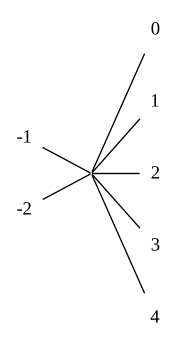
Create a
Topologythat connects all edges through a single node.These types of “\(n\)-body topologies” are particularly important for
check_reaction_violations()andconservation_rules.- Parameters
number_of_initial_states – The number of
incoming_edge_ids(initial_states).number_of_final_states – The number of
outgoing_edge_ids(final_states).
Example
>>> topology = create_n_body_topology(
...    number_of_initial_states=2,
...    number_of_final_states=5,
... )
>>> topology
Topology(nodes=..., edges...)
>>> len(topology.nodes)
1
>>> len(topology.incoming_edge_ids)
2
>>> len(topology.outgoing_edge_ids)
5
- class Transition(*args, **kwds)[source]#
Bases:
ABC,Generic[EdgeType,NodeType]Mapping of edge and node properties over a
Topology.This interface class describes a transition from an initial state to a final state by providing a mapping of properties over the
edgesandnodesof itstopology. Since aTopologybehaves like a Feynman graph, edges are considered as “states” and nodes are considered asinteractionsbetween those states.There are two implementation classes:
FrozenTransition: a complete, hashable and ordered mapping of properties over theedgesandnodesin itstopology.MutableTransition: comparable toMutableTopologyin that it is used internally when finding solutions through theStateTransitionManageretc.
These classes are also provided with mixin attributes
initial_states,final_states,intermediate_states, andfilter_states().- abstract property topology: Topology#
Topologyover whichstatesandinteractionsare defined.
- property initial_states: Dict[int, EdgeType]#
Properties for the
incoming_edge_ids.
- property final_states: Dict[int, EdgeType]#
Properties for the
outgoing_edge_ids.
- class FrozenTransition(topology: Topology, states, interactions)[source]#
Bases:
Transition,Generic[EdgeType,NodeType]Defines a frozen mapping of edge and node properties on a
Topology.- states: FrozenDict[int, EdgeType]#
- interactions: FrozenDict[int, NodeType]#
- unfreeze() MutableTransition[EdgeType, NodeType][source]#
Convert into a
MutableTransition.
- convert() FrozenTransition[EdgeType, NodeType][source]#
- convert(state_converter: Callable[[EdgeType], NewEdgeType]) FrozenTransition[NewEdgeType, NodeType]
- convert(*, interaction_converter: Callable[[NodeType], NewNodeType]) FrozenTransition[EdgeType, NewNodeType]
- convert(state_converter: Callable[[EdgeType], NewEdgeType], interaction_converter: Callable[[NodeType], NewNodeType]) FrozenTransition[NewEdgeType, NewNodeType]
Cast the edge and/or node properties to another type.
- class MutableTransition(topology: Topology, states: Mapping[int, EdgeType] = NOTHING, interactions: Mapping[int, NodeType] = NOTHING)[source]#
Bases:
Transition,Generic[EdgeType,NodeType]Mutable implementation of a
Transition.Mainly used internally by the
StateTransitionManagerto build solutions.- compare(other: MutableTransition, state_comparator: Optional[Callable[[EdgeType, EdgeType], bool]] = None, interaction_comparator: Optional[Callable[[NodeType, NodeType], bool]] = None) bool[source]#
- freeze() FrozenTransition[EdgeType, NodeType][source]#
Convert into a
FrozenTransition.