





Custom topologies#
As illustrated in Generate transitions, the StateTransitionManager offers you a bit more flexibility than the façade function generate_transitions() used in the main Usage page. In this notebook, we go one step further, by specifying a custom Topology via StateTransitionManager.topologies.
2-to-2 topology#
As a simple example, we start with a 2-to-2 scattering topology. We define it as follows:
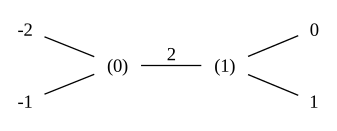
First, we construct a StateTransitionManager for the transition \(K^-K^+ \to \pi^+\pi^-\). The constructed Topology can then be inserted via its topologies attribute:
stm = StateTransitionManager(
    initial_state=["K-", "K+"],
    final_state=["pi-", "pi+"],
    formalism="canonical",
)
stm.set_allowed_interaction_types([InteractionType.STRONG, InteractionType.EM])
stm.topologies = (topology,)  # tuple is immutable
For the rest, the process is just the same as in Generate transitions:
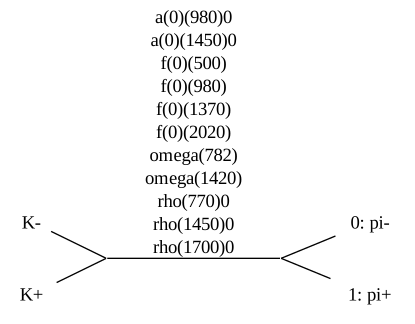
problem_sets = stm.create_problem_sets()
reaction_kk = stm.find_solutions(problem_sets)
Warning
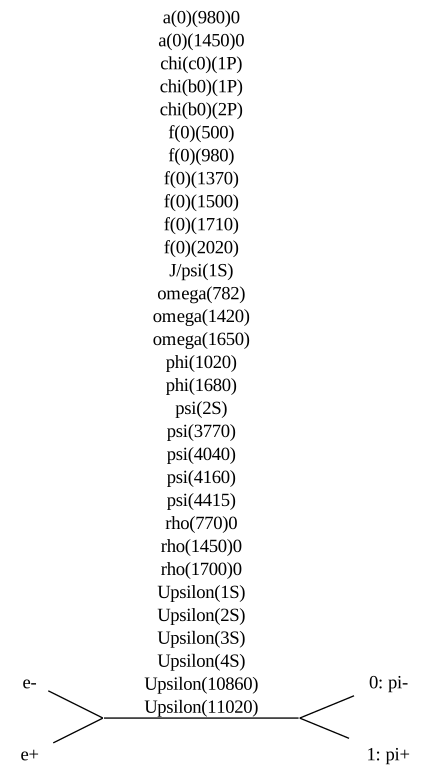
It is not yet possible to give the initial state a certain energy. So some collider process like \(e^-e^+\to\pi^+\pi\) does not result in a large number of resonances.
stm.initial_state = ["e-", "e+"]
problem_sets = stm.create_problem_sets()
reaction_ep = stm.find_solutions(problem_sets)
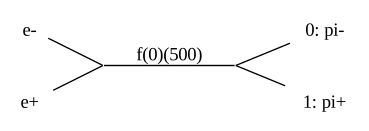
What can do at most, is switch off MassConservation, either through the constructor of the StateTransitionManager, or by modifying ProblemSet.
stm = StateTransitionManager(
    initial_state=["e-", "e+"],
    final_state=["pi-", "pi+"],
    formalism="canonical",
    mass_conservation_factor=None,
)
stm.set_allowed_interaction_types([InteractionType.STRONG, InteractionType.EM])
stm.topologies = [topology]
problem_sets = stm.create_problem_sets()
reaction_ep_no_mass = stm.find_solutions(problem_sets)